Showing posts with label Research. Show all posts

Thursday, 9 December 2010

The Hair Attacks!

The next part of the scene finally involves the hair leaping into action of its own accord, forming 'hands' from the ends of its pigtails as it does so. I wasn't sure how to go about this at first in order to get the movement right; I knew it had to be snappy in order to show the violence of the attack, but at the same time needed correct anticipation and build up to pull it off without being too slow. Before I began I asked someone to take photographs of my own hands in various positions/from various angles which I thought would make useful references for the hair hands, which you can see below.


As I was posing and trying to work out how exactly the hands would work best, I realised I was using my arms to represent the pigtails since human arms are naturally far longer than those of my character. It was then I made the connection with the arm positions of ballet (I used to dance regularly before I came to university): the starting position 'bras bas' looks very similar to how the pigtails fall around my character's feet before the hair comes alive. Or at least it would if humans arms where floor length, but you get the idea.


So I thought why not have the hair start to raise like a ballet dancer would raise their arms to second position?


It worked better than I thought it would and made a good starting point for the action. From there I decided the pigtails needed an extreme accented pose before they went for the neck, again to exaggerate the violence and create more impact. Also I wanted to give the feel if a predator leaping into action... Having the pigtails stretched up as far as they can go was inspired by Niche (see below), whose pigtails often spike up into swords ready to attack the moment she gets agitated.


I didn't put a frame in between the peaked pigtails and the throat grab as I honestly felt it didn't need one. An extra frame would have slowed the lunging movement down, meaning less impact and less exaggerated reaction. I did, however, stretch the pigtails so they were far longer then they out to have been on the downward arc in order to make them flow better, and again, more exaggeration on the attack.


Throat grab cleaned up with hair detail added.

Animation References

Below are pages scanned from Richard Williams' 'The Animator's Survival Kit', by far the most useful and informative book I've ever owned. These pages are my main sounce of reference for the principles of animation I most want to focus on improving in my work. First one: flexibility. Vital for ensuring my character isn't as stiff as an ironing board.


Takes and Accents

Surprise Anticipation - My poor character's going to be shocked a lot.

Invisible Anticipation

Weight and Follow Through


Whips and Waves - Especially useful for animating flowing hair.

Eyes Are The Windows To The Soul


Through studying the principles of acting and body language I've discovered just how important the eyes are in conveying a character's thought process. Eyes are very expressive and are widely regarded as the windows of the soul, so I intend to take extra care when animating my characters eyes and facial expressions. I intentionally have her a large head to encompass her larger than average eyes for this very reason, and I intend to make the most of it. While the fight scene will be to fast and action filled for any lingering, contemplative looks, I still think the principles of eye language are useful to know and to take into consideration. An interesting document detailing the secret messages eyes send us can be found here.

Ed Hooks

A useful piece written by Ed Hooks, found in his Acting For Animators Newsletter April 2010.

"CRAFT NOTES
STAGE ACTING VS. ANIMATION ACTING

A simple improvisation that I include in all of my Acting for Animators workshops immediately highlights the difference between the way that animators perceive and apply acting and the way that stage actors do it. The Status-Negotiation exercise works this way. Two volunteers from the class are positioned at opposing sides of the stage, one far left and the other far right, facing each another. One is told he is the king (or queen), and the other is a slave. They are to pass one another in the castle hallway and exchange greetings.

An animator, given these instructions, will inevitably start imagining how a king looks and moves, or how a slave might grovel. When I say, “Action!” he will illustrate physically the idea he has in his head about how the movement should look. It is not that he is wrong, only that this approach guarantees stereotype movement.

Consider how two experienced actors would carry out the same improvisation. They have been instructed that one is the king and the other is the slave. A stage actor will respond, “Yes, and…?” In other words, “What am I doing as the king?” He will not be thinking of how his character moves or looks at all! (Notice I specified “experienced” actors. A novice actor might well do the same thing the animator does because he has not learned better yet.)

Animators think in terms of movement. Stage actors think in terms of communication, intention and emotion. Get those elements right, and they will dictate to you how the character moves.

After coaching this improvisation hundreds of times, occasionally with master animators as students, I have come to recognize that this is just the nature of the animator, to think visually, and there is nothing wrong with it. However, there is a marvelous object lesson. After the first time they move back and forth across the stage, I instruct them with an actor-type adjustment. “Give yourself a place where you are going, and we’ll do it again.” That’s all, just a place where they are going. It doesn’t matter where that might be. The purpose of movement is destination. Once the animators have a strong destination, they will no longer be thinking about movement, and they will cross in the hallway differently. Their bodies will move differently, more naturally, less self-consciously. After everyone in the workshop recognizes what has observed the improved movement, I instruct with variations of destinations. “The queen is in labor. Go to her.” “You spilled wine on the royal carpet and must clean it up right away.” “You are having a romantic relationship with the chamber maid, and this is your time together.”

The fact that an animator thinks visually, in terms of movement, is why it might be a problem when he acts out his own video reference for a sequence. He turns on the recorder, positions himself in front of the camera – and is self-directing, once again trying to imagine movement rather than intention. This is the reason I suggest that an animator have a friend act out the reference if possible. Just give your friend the situation. Don’t tell him how to move or what you want to see. “You’re trying to catch a dragonfly in a net.” You don’t say, “Be sure you look very frustrated.” Simply let him try to catch the dragonfly. That’s your reference.

What is your personal definition of good acting in animation? I will bet it has something to do with the creation of “believable” movement, even if caricatured. The point I am making is that acting training will not enlighten you about how believable movement looks. Acting training will encourage you to first seek the purpose of movement and then to be mindful of how it looks.

Walt Disney was very smart about these things. In his famous 1935 memo to Don Graham, he observed astutely, “Many [animators] do not realize what really makes things move, why they move, what the force behind the movement is. … [T]he mind is the pilot. We think of things before the body does them.” That is 100 percent correct."

This was very interesting to read, as I've always thought that acting out references yourself was preferable to getting someone else to do it for you. I always feel I can understand the movement better after trying it myself, I highly doubt I'd be able to animate as well if I only watched people... But I do agree that its easy to over think things when you try to act on your own, I always find myself trying to plan the movement out in my head before I record, and then it always turns out stiff and horrible. Thankfully that wasn't the case so much with my video references for this project, as for the most part I completely winged them. They slower ones such as trying my hair and pulling myself up onto the desk were very planned, but when it came to the most important part (the strangling), I honestly had no idea how to go about it. So I just when crazy on a whim and ended up in a heap on the floor, laughing at myself. Granted the laughing had to go, but when I watched the footage it looks so much fresher and more dynamic than everything else I'd done, so I did a few more takes or similar actions to perfect them. I never considered my lack of planning to be a benefit at the time, but after reading this and looking back, it really was. Rather than planning out movements in my head, I was simply trying to imagine what I would do if my hair really was strangling me, and acted the first impulse that came to mind. His theory really does work! Now I just have to take this into consideration the text time I'm filming references; I think from now on I will try to ask someone else to act for me first, then attempt to copy their actions myself afterwards so I can still get a personal feel for the movement, Best of both worlds?

Thursday, 18 November 2010

Animated Hair References

As much as having long hair of my own is handy, it still doesn't make for the best reference when you're trying to animate hair doing something other than just falling down your back. I know animating long hair well is very difficult, and I find I can often judge just how big a budget for a production is just by how well they animate hair since that's usually one of the first things that gets skimped on when money gets tight. And no wonder, its a time consuming task! Below are some examples I've found of what I think think to be well animated long hair:


First up is the second ending theme to the Fullmetal Alchemist: Brotherhood anime, which showcases one of the best examples of hair flowing in the wind I've ever seen (and I've seen a of anime hair flowing in the wind). The clip in question is at 0:12-0:23, and I love how the animators have taken the time and effort to show all the individual strands blowing in such a convincing and diverse manner, varying the way they waft over her face each time rather that just animating it once and sticking it on a loop which is usually the trend in such instances. Naturally this is far too detailed for what I hope to achieve, but it still makes a great reference and really demonstrates the whip-like 'figure of eight' movement the strands follow as they ripple.


Skip to 1:02 for this one; the brief clip from the Kobato anime as she spins around to face the viewer. Yes its intensely sugary and in slow motion, but I actually find the slowness helps me read the movement better, especially since this whipping of the hair is very over exaggerated. Normal hair of that length would barely move from such a small turn, considering its weight. But regardless, exaggeration and fluidity is what I'm going for, and I feel this demonstrates both quite well, albeit rather hazily on the visual side.


Skip to 0:43. More relevant to my interests this time, this short scene demonstrates Niche's (the girl I referenced for my character design some weeks earlier) hair sword in action, and for once they're animated very fluidly with great exaggerated perspective and weight. While its still obvious her swords are made of hair by how flexibly they move, they still have an appropriate density to them that shows they have a life of they're own and aren't merely strands being blown by the wind. That's the kind of balance I want to strike with by character's hair once it comes alive, as I don't want the hair to appear too soft and weak to do any damage, yet at the same time I don't want it to be too rigid as it will just appear stiff and unrealistic.


Pocahontas: were every other scene shows her hair billowing epically in the wind. Thankfully her hair is animated beautifully, as can be expected of Disney, and makes for a great reference for the follow-through and weight principles of animation which I'm trying by best to improve in my work.


A line test I found which was inspired by the Pocahontas style, this beautifully demonstrates hair whipping round as it follows a sharp head turn. I find studying it to be very useful, as I could clearly see how the hair follows an arc as it moves. A common factor I've noticed while watching well animated hair is that the strands seem to flow in figures of eight, the tips always flicking back the opposite way to the upper body of hair depending on the direction of movement. Hopefully studying these references will allow me to animate my character's hair convincingly.

Tex Avery


Tex Avery is well known as one of Wanrer Bros. most influencial animators, steering the house stryle away from Disney-esque animation and more towards flamboyant, vastly over exaggerated cartoons that could appeal to both children and adults alike. His cartoons are revered for their wit, irony, and sarcasm, a refreshing take on animated comedy that I feel could be of use to me as I work on animating my own character. Above is the 1955 cartoon "Chilly Willy: The Legend Of Rockabye Point" directed by Avery, one of my personal favourites of his, and is showcases how brilliantly simple yet well executed his gags are, so much so that that never cease to get old despite the entire six minute cartoon focusing on repeating the same instance over and over again. The way the gag is carried out becomes increasingly over the top each time to the point of being rediculous; the part being seeing the mightly polar bear being thwarted by the tiny penguin he tried so hard to keep away from his food.

While my narrative isn't intended to be pure gag-riddled comedy (I want to go for something more subtle and fluid to really push my technical skills), the exaggerated poses and use of comic timing in Avery's cartoons makes an excellent reference point, and I hope to utilise some of these principles in my own work.

Thursday, 21 October 2010

Acting Research!


Charlie Chaplin was the slap-stick master of the silent movie era and is easily one of the best examples of acting you can ever hope to find. The above clip from his 1931 film 'City Lights' is an excellent example of staging and comedic timing, as well as acting in general. The great thing about Chaplin's films is that he rarely ever changes his expression, yet still manages to convey a wide range on emotions and connect with his audience through bodily action alone. I chose the boxing scene in particular as it relates to my own fight scene I have planned with my character, and I hope to implement the principles used here in my own work in order to make my character more believable. One of the first things I noticed from watching was that the two fighters almost always stand in profile when they face each other, making their postures and lunges very easy to read so the audience has no trouble following the action despite the lack of sound. They also mirror each other, often dancing around the ring in circles rather than actually fighting, and this gives the composition of the scene a nice feeling of balance and prevents it from becoming to hectic, as well as allowing for the comedy to build up as the same gag is repeated to greater effect. The camera follows the two around, sticking to them like glue so they are almost always framed perfectly in the center of the shot, ensuring that the audience doesn't become distracted by anything else in the background as well as, again, making the movement very easy to follow. The poses are exaggerated and defined well; if you were to imagine this film as a story board you would have no trouble understanding what was going on even in static pictures. I think this is the key element I need to focus on - my storyboards must be crystal clear and make good use of staging in order to properly get my story across. I likewise intend to keep my character framed in the middle of the shot during her fight scene, and I want each storyboard to contain a pose at the peak of movement (the accent) so each stage of the fight flows clearly from one pose to the next as it develops, much like Chaplin's boxing. Furthermore, if I do this I would then be able to use said storyboards as keyframes to help get me started animating.


Back to animation, 'The Sorcerer's Apprentice' from Disney's Fantasia is another great example of character acting, this time in a similar context to what I'm aiming for with my story. Like my character, Mickey finds himself overwhelmed by what was previously an inanimate object under his control, putting him in grave peril as the brooms revel in their new found lives. What I really love about this, and in particular the scene at 5:03, is Mickey's face as he struggles against the current to try and get to the steps, and later as he tries to climb out the well against the waves of the water being thrown in. Rather than just being a simple change from one facial expression to another, his expression contorts and flickers in between the two accented points as the water hits him; his eyes squint and he shakes his head while gasping for breath, making the struggle so much more believable. I really want to include detailed secondary animation like this in my own work, as I think its the tiny little details that most people often overlook that really make a character come alive.

Monday, 27 September 2010

Limbless Wonders

Perhaps I'm more evil inside than imagine, but while thinking of different ways the battle between my character and her hair could be choreographed, I suddenly got the mental image of the hair grabbing her hands and pulling them clean off from her body, essentially rendering her almost helpless (or at the very least, having a huge disadvantage). Naturally I don't want this to be a horrible, gory affair, far from it; my aim is to create a quirky, comical, cartoony animation where the violence is lends to the humour and is anything but realistic. Keeping that in mind, in order for limbs to be torn off without bloodshed the character would logically either have to be a doll of some kind (which I don't want), or never have arms to begin with, only hands. I remember a scene from the opening cinematic of Rayman 3: Hoodlum Havoc where the limbless hero Rayman is fast asleep and his friends are trying to save him from the bad guys by lifting him out the way by his hands. Since his hands seem to only be attached to Rayman's body magically, the weight of his body proves too great and the hands pop loose. (Skip to 2:12 in the video below.) This is naturally played for laughs and is intended to make the situation more dire, but in a way that's fun to watch rather than scary.


Below are more examples of magically limbless video game characters that I think will make useful references should I decide to go down this route with my character design.


(Rayman - Rayman 2: The Great Escape)


(Dimentio - Super Paper Mario)


(NiGHTS - NiGHTS: Journey of Dreams)


(Miis - Wii Sports Resort)

I especially like how NiGHTS and the Miis have no arms to speak of, but still have legs connecting their feet to their bodies. I think that if I do decide to make my final character design have floating hands, I may still give her legs so I can demonstrate solid walk and run movements. My goal in this project is to develop my skill as a character animator, after all. I need to focus and ensure my character design doesn't hinder my animation and what acting the character is capable of by being too weird.

Saturday, 25 September 2010

Hairy Limbs

Before starting my character design I've scoured my memory and the Internet for existing characters in video games and animation that use their hair as hands/limbs or something else out of the ordinary in order to get an idea of different kinds of hair related powers and what my character should and shouldn't be able to do with her hair. ...Or more accurately, what my character's hair should be able to do to my character. She naturally won't get much choice in the matter, poor thing. But regardless, I think it'll be good practice to look at hair powers from both perspectives as I was originally thinking of my having my character star in a game where she used her hair based powers to get around due to lack of arms of her own... My idea may have developed into a narrative piece since then, but I still want to keep my options open in terms of character design so I can come up with something that really works and fits the tone of the story I'm trying to tell.


(Tiny Kong)

(Dixie Kong)

First we have Tiny Kong and Dixie Kong from the Donkey Kong video game series; two female monkey with long blonde hair who use their lengthy locks as weapons of mass destruction! ...Okay, so that's a slight exaggeration, but having played the games that they each appear in I can say that, while simple, their hair related powers work interestingly as means of transportation and combat. Both Tiny and Dixie have the ability to spin/hover through the air using their signature 'ponytail twirl' move, which allows them to clear large distances otherwise impossible to jump. Dixie can also use her ponytail to grab and throw enemies, while Tiny is capable of using her pigtails as weapons to whack enemies with once close enough. While the hair in these cases isn't particularly personified, its still a nice starting point.


Next we have Midna from The Legend of Zelda: Twilight Princess, who is a brilliant example of hair having a life of its own. While she's in clearly in control of her hair at all all times, her ponytail leaps into a grotesquely creepy hand that hover above her head in front of her, allowing her to grab, move, and throw things much larger than herself with relative ease. I really want my character's hair to have a distinctive hand shape with a narrower wrist so it's easily defined from the rest of the hair/arm like Midna's. I think this is important for the viewer to read the action clearly. I also really like how Midna's hair hand has long, pointed/jagged finger tips... In this case it's probably to make the hand more intimidating as it's being used as a weapon, since her hair normally has flat, rounded edges. But I'm thinking of having my character's hair have a more pointed ends so they hand easily mesh into fingers, so I think pointed fingers will work well for that.


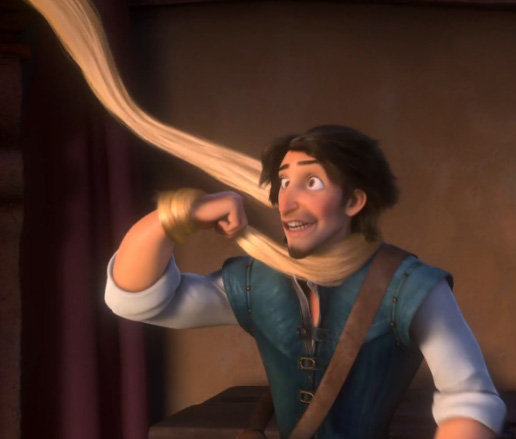
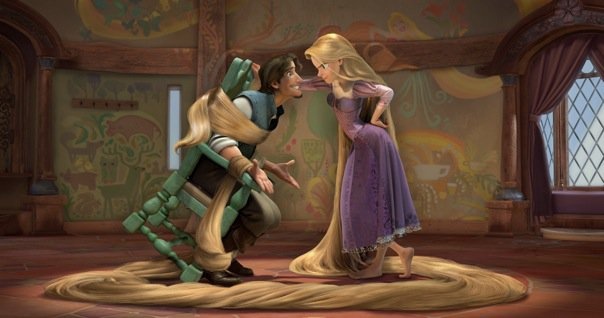
Tangled, Disney's up-and-coming adaptation of the Rapunzel fairy tale, also decides to take a twist with the unusually long hair and similarly has Rapunzel able to control its actions at will to capture and tie up intruders. While this isn't really any different from the other examples other than in terms of sheer hair length, its nice to see a design where the hair isn't tied up somehow and yet is still perfectly functional. However this would detract from the conflict I want my character to have with her long hair as I need to her be annoyed and exasperated with how much it gets in the way, especially while wearing it down.


Video game heroine Bayonetta takes thinks to the extreme, her entire outfit consisting soley of her own hair wrapped magically around her body. Unfortunately this means that whenever she uses it as a weapon in battle, she becomes completely naked in the process... But regardless, having hair that can transform into a demonic dragon on a whim is certainly an interesting power and a great way to personify her hair as having an identity of its own. It's a little too much to be considered for my character, though...


Last but not least we have Niche, a young girl character from the anime Tegami Bachi or 'Letter Bee' in English. Likewise she uses her hair as weapons and extra limbs, but seems to have a far more diverse range of what she can do with it due to it's unnatural strength. Her hairy abilities range from simply picking things up/carrying them/throwing them around to climbing, aerial acrobatics, using her pigtails as swords, shields, and even skis and spider legs for moving around while her body is suspended in mid air. Her hair is also able to stretch/grow as much as the situation demands it, always snapping back to its original length when not in use, and she even uses it to gesture instead of or as well as her real arms for added exaggerated effect. All in all I really like how she's not limited to only one or two actions with her hair, making it feel like it's really alive and a creature in its own right, though I know a lot of what she can do it too fantasy orientated to apply to my character. Looking at these characters has made me realise I definitely want my character to have pigtails, though, as these seem to allow for the most interesting movements, and they'll have the added bonus of looking and acting like two extra arms rather than just one.